|
| Packet * | getAttachedPacket () |
| | Get a pointer to the Packet this layer is attached to (if any). More...
|
| |
| Packet const * | getAttachedPacket () const |
| | Get a pointer to the Packet this layer is attached to (if any). More...
|
| |
| void | allocData (size_t dataLen, bool zeroInit=true) |
| | Requests the layer to allocate a new data buffer of the specified length. More...
|
| |
| template<typename T , typename... Args> |
| Layer * | constructNextLayer (uint8_t *data, size_t dataLen, Args &&... extraArgs) |
| | Construct the next layer in the protocol stack. No validation is performed on the data. More...
|
| |
| template<typename T , typename... Args> |
| Layer * | constructNextLayer (uint8_t *data, size_t dataLen, Packet *packet, Args &&... extraArgs) |
| |
| template<typename TFactory , typename... Args> |
| Layer * | constructNextLayerFromFactory (TFactory factoryFn, uint8_t *data, size_t dataLen, Args &&... extraArgs) |
| | Construct the next layer in the protocol stack using a factory functor. More...
|
| |
| template<typename TFactory , typename... Args> |
| Layer * | constructNextLayerFromFactory (TFactory factoryFn, uint8_t *data, size_t dataLen, Packet *packet, Args &&... extraArgs) |
| | Construct the next layer in the protocol stack using a factory functor. More...
|
| |
| template<typename T , typename... Args> |
| Layer * | tryConstructNextLayer (uint8_t *data, size_t dataLen, Args &&... extraArgs) |
| |
| template<typename T , typename... Args> |
| Layer * | tryConstructNextLayer (uint8_t *data, size_t dataLen, Packet *packet, Args &&... extraArgs) |
| |
| template<typename T , typename TFallback , typename... Args> |
| Layer * | tryConstructNextLayerWithFallback (uint8_t *data, size_t dataLen, Args &&... extraArgs) |
| | Try to construct the next layer in the protocol stack with a fallback option. More...
|
| |
| template<typename T , typename TFallback , typename... Args> |
| Layer * | tryConstructNextLayerWithFallback (uint8_t *data, size_t dataLen, Packet *packet, Args &&... extraArgs) |
| |
| template<typename TFallback , typename TFactory , typename... Args> |
| Layer * | tryConstructNextLayerFromFactoryWithFallback (TFactory factoryFn, uint8_t *data, size_t dataLen, Args &&... extraArgs) |
| | Try to construct the next layer in the protocol stack using a factory functor with a fallback option. More...
|
| |
| template<typename TFallback , typename TFactory , typename... Args> |
| Layer * | tryConstructNextLayerFromFactoryWithFallback (TFactory factoryFn, uint8_t *data, size_t dataLen, Packet *packet, Args &&... extraArgs) |
| | Try to construct the next layer in the protocol stack using a factory functor with a fallback option. More...
|
| |
| virtual void | serializeLayer (ObjectScope &serializer) const |
| |
| template<typename T > |
| static bool | canReinterpretAs (const uint8_t *data, size_t dataLen) |
| | Check if the data is large enough to reinterpret as a type. More...
|
| |
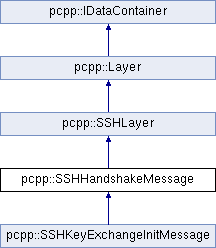
A class representing all of the non-encrypted SSH handshake messages. An handshake message typically has the following structure:
0 1 2 3 4 5 6
+---------+---------+---------+---------+---------+---------+----------- ---------+
| Packet Length | Padding | Message | Message .... Padding |
| | Length | Type | Content .... |
+---------------------------------------+---------+---------+----------- ---------+
The first 4 bytes hold the packet length, followed by 1 byte that holds the padding length (which comes at the end of the message), then 1 byte that holds the message type (which can be of type SSHHandshakeMessage::SSHHandshakeMessageType) and then the message content. At the end of the content there is typically padding.
This class provides access to all of these values. The message content itself is not parse with the exception of SSHKeyExchangeInitMessage which inherits from this class and provides parsing of the Key Exchange Init message.
 Public Member Functions inherited from pcpp::SSHLayer
 1.9.1
1.9.1