|
| enum class | QuicPacketType : uint8_t {
Initial = 0
, ZeroRTT = 1
, Handshake = 2
, Retry = 3
,
VersionNegotiation = 253
, OneRtt = 254
} |
| |
| enum class | QuicHeaderForm : uint8_t { ShortHeader = 0
, LongHeader = 1
} |
| |
| static QuicV1Layer * | parseQuicLayer (uint8_t *data, size_t dataLen, Layer *prevLayer, Packet *packet) |
| |
| static bool | isQuicPort (uint16_t port) |
| |
| Packet * | getAttachedPacket () |
| | Get a pointer to the Packet this layer is attached to (if any). More...
|
| |
| Packet const * | getAttachedPacket () const |
| | Get a pointer to the Packet this layer is attached to (if any). More...
|
| |
| void | allocData (size_t dataLen, bool zeroInit=true) |
| | Requests the layer to allocate a new data buffer of the specified length. More...
|
| |
| template<typename T , typename... Args> |
| Layer * | constructNextLayer (uint8_t *data, size_t dataLen, Args &&... extraArgs) |
| | Construct the next layer in the protocol stack. No validation is performed on the data. More...
|
| |
| template<typename T , typename... Args> |
| Layer * | constructNextLayer (uint8_t *data, size_t dataLen, Packet *packet, Args &&... extraArgs) |
| |
| template<typename TFactory , typename... Args> |
| Layer * | constructNextLayerFromFactory (TFactory factoryFn, uint8_t *data, size_t dataLen, Args &&... extraArgs) |
| | Construct the next layer in the protocol stack using a factory functor. More...
|
| |
| template<typename TFactory , typename... Args> |
| Layer * | constructNextLayerFromFactory (TFactory factoryFn, uint8_t *data, size_t dataLen, Packet *packet, Args &&... extraArgs) |
| | Construct the next layer in the protocol stack using a factory functor. More...
|
| |
| template<typename T , typename... Args> |
| Layer * | tryConstructNextLayer (uint8_t *data, size_t dataLen, Args &&... extraArgs) |
| |
| template<typename T , typename... Args> |
| Layer * | tryConstructNextLayer (uint8_t *data, size_t dataLen, Packet *packet, Args &&... extraArgs) |
| |
| template<typename T , typename TFallback , typename... Args> |
| Layer * | tryConstructNextLayerWithFallback (uint8_t *data, size_t dataLen, Args &&... extraArgs) |
| | Try to construct the next layer in the protocol stack with a fallback option. More...
|
| |
| template<typename T , typename TFallback , typename... Args> |
| Layer * | tryConstructNextLayerWithFallback (uint8_t *data, size_t dataLen, Packet *packet, Args &&... extraArgs) |
| |
| template<typename TFallback , typename TFactory , typename... Args> |
| Layer * | tryConstructNextLayerFromFactoryWithFallback (TFactory factoryFn, uint8_t *data, size_t dataLen, Args &&... extraArgs) |
| | Try to construct the next layer in the protocol stack using a factory functor with a fallback option. More...
|
| |
| template<typename TFallback , typename TFactory , typename... Args> |
| Layer * | tryConstructNextLayerFromFactoryWithFallback (TFactory factoryFn, uint8_t *data, size_t dataLen, Packet *packet, Args &&... extraArgs) |
| | Try to construct the next layer in the protocol stack using a factory functor with a fallback option. More...
|
| |
| virtual void | serializeLayer (ObjectScope &serializer) const |
| |
| template<typename T > |
| static bool | canReinterpretAs (const uint8_t *data, size_t dataLen) |
| | Check if the data is large enough to reinterpret as a type. More...
|
| |
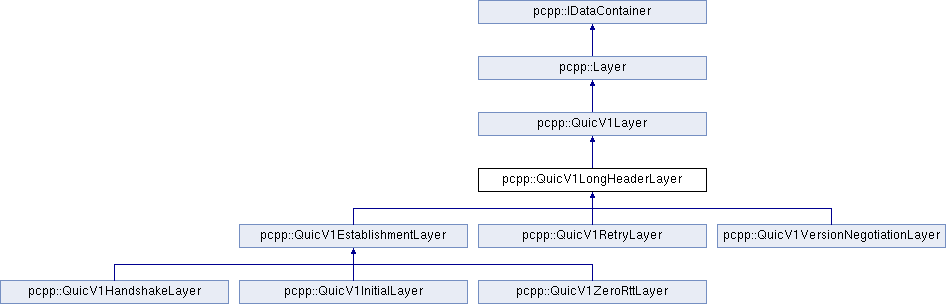
Base class for all QUIC v1 packet forms that use the long header (Initial, 0-RTT, Handshake, Retry and Version Negotiation). Provides parsing shared by all of them: the QUIC version and the Destination/Source Connection IDs, which sit at a fixed offset (Destination) or immediately after it (Source) in every long-header packet
 Public Member Functions inherited from pcpp::QuicV1Layer
 1.9.1
1.9.1