|
| Packet * | getAttachedPacket () |
| | Get a pointer to the Packet this layer is attached to (if any). More...
|
| |
| Packet const * | getAttachedPacket () const |
| | Get a pointer to the Packet this layer is attached to (if any). More...
|
| |
| void | allocData (size_t dataLen, bool zeroInit=true) |
| | Requests the layer to allocate a new data buffer of the specified length. More...
|
| |
| template<typename T , typename... Args> |
| Layer * | constructNextLayer (uint8_t *data, size_t dataLen, Args &&... extraArgs) |
| | Construct the next layer in the protocol stack. No validation is performed on the data. More...
|
| |
| template<typename T , typename... Args> |
| Layer * | constructNextLayer (uint8_t *data, size_t dataLen, Packet *packet, Args &&... extraArgs) |
| |
| template<typename TFactory , typename... Args> |
| Layer * | constructNextLayerFromFactory (TFactory factoryFn, uint8_t *data, size_t dataLen, Args &&... extraArgs) |
| | Construct the next layer in the protocol stack using a factory functor. More...
|
| |
| template<typename TFactory , typename... Args> |
| Layer * | constructNextLayerFromFactory (TFactory factoryFn, uint8_t *data, size_t dataLen, Packet *packet, Args &&... extraArgs) |
| | Construct the next layer in the protocol stack using a factory functor. More...
|
| |
| template<typename T , typename... Args> |
| Layer * | tryConstructNextLayer (uint8_t *data, size_t dataLen, Args &&... extraArgs) |
| |
| template<typename T , typename... Args> |
| Layer * | tryConstructNextLayer (uint8_t *data, size_t dataLen, Packet *packet, Args &&... extraArgs) |
| |
| template<typename T , typename TFallback , typename... Args> |
| Layer * | tryConstructNextLayerWithFallback (uint8_t *data, size_t dataLen, Args &&... extraArgs) |
| | Try to construct the next layer in the protocol stack with a fallback option. More...
|
| |
| template<typename T , typename TFallback , typename... Args> |
| Layer * | tryConstructNextLayerWithFallback (uint8_t *data, size_t dataLen, Packet *packet, Args &&... extraArgs) |
| |
| template<typename TFallback , typename TFactory , typename... Args> |
| Layer * | tryConstructNextLayerFromFactoryWithFallback (TFactory factoryFn, uint8_t *data, size_t dataLen, Args &&... extraArgs) |
| | Try to construct the next layer in the protocol stack using a factory functor with a fallback option. More...
|
| |
| template<typename TFallback , typename TFactory , typename... Args> |
| Layer * | tryConstructNextLayerFromFactoryWithFallback (TFactory factoryFn, uint8_t *data, size_t dataLen, Packet *packet, Args &&... extraArgs) |
| | Try to construct the next layer in the protocol stack using a factory functor with a fallback option. More...
|
| |
| virtual void | serializeLayer (ObjectScope &serializer) const |
| |
| template<typename T > |
| static bool | canReinterpretAs (const uint8_t *data, size_t dataLen) |
| | Check if the data is large enough to reinterpret as a type. More...
|
| |
A class for representing packet trailer (a.k.a footer or padding) which refers to supplemental data placed at the end of a block of data being stored or transmitted, which may contain information for the handling of the data block, or just mark its end (taken from Wikipedia: https://en.wikipedia.org/wiki/Trailer_(computing) )
There are various reasons for adding a packet trailer, one of the most famous is FCS (Frame check sequence) which refers to the extra error-detecting code added to a frame. Another usage is padding which means adding data to reach a minimum required packet length.
Although this layer inherits from the Layer class, it is not a standard layer in the sense that it can't be constructed by the user. This layer may be only be constructed in the Packet class, in the process of parsing the packet and creating the layers; if at the end of the parsing process there is data left that is not allocated to any layer, it's assumed to be the packet trailer and an instance of this class is created. This means this layer can only exist as the last layer in a packet, if a packet trailer indeed exists.
No layer can be added by the user after this layer (trying to do that will result with an error).
This layer can be removed by the user or extended/shortened, as any layer.
It also contains method to extract the trailer data
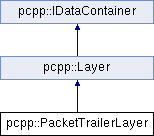
 Public Member Functions inherited from pcpp::Layer
 1.9.1
1.9.1