|
| | HttpRequestLayer (uint8_t *data, size_t dataLen, Layer *prevLayer, Packet *packet) |
| |
| | HttpRequestLayer (HttpMethod method, const std::string &uri, HttpVersion version) |
| |
| | HttpRequestLayer (const HttpRequestLayer &other) |
| |
| HttpRequestLayer & | operator= (const HttpRequestLayer &other) |
| |
| HttpRequestFirstLine * | getFirstLine () const |
| |
| std::string | getUrl () const |
| |
| std::string | toString () const override |
| |
| HeaderField * | addField (const std::string &fieldName, const std::string &fieldValue) override |
| |
| HeaderField * | addField (const HeaderField &newField) override |
| |
| HeaderField * | insertField (HeaderField *prevField, const std::string &fieldName, const std::string &fieldValue) override |
| |
| HeaderField * | insertField (HeaderField *prevField, const HeaderField &newField) override |
| |
| OsiModelLayer | getOsiModelLayer () const override |
| |
| HeaderField * | getFieldByName (std::string fieldName, int index=0) const |
| |
| HeaderField * | getFirstField () const |
| |
| HeaderField * | getNextField (HeaderField *prevField) const |
| |
| int | getFieldCount () const |
| |
| HeaderField * | addEndOfHeader () |
| |
| virtual HeaderField * | insertField (std::string prevFieldName, const std::string &fieldName, const std::string &fieldValue) |
| |
| bool | removeField (HeaderField *fieldToRemove) |
| |
| bool | removeField (std::string fieldName, int index=0) |
| |
| bool | isHeaderComplete () const |
| |
|
void | parseNextLayer () override |
| | Currently set only PayloadLayer for the rest of the data.
|
| |
| size_t | getHeaderLen () const override |
| |
|
void | computeCalculateFields () override |
| | Does nothing for this class.
|
| |
| | ~Layer () override |
| |
| Layer * | getNextLayer () const |
| |
| Layer * | getPrevLayer () const |
| |
| ProtocolType | getProtocol () const |
| |
| bool | isMemberOfProtocolFamily (ProtocolTypeFamily protocolTypeFamily) const |
| |
| uint8_t * | getData () const |
| |
| size_t | getDataLen () const |
| |
| uint8_t * | getLayerPayload () const |
| |
| size_t | getLayerPayloadSize () const |
| |
| bool | isAllocatedToPacket () const |
| |
| void | copyData (uint8_t *toArr) const |
| | Copy the raw data of this layer to another array. More...
|
| |
| size_t | copyData (uint8_t *dest, size_t destSize) const |
| | Copy the raw data of this layer to another array, with a specified maximum size. More...
|
| |
| void | serialize (ISerializer &serializer) const |
| |
| uint8_t * | getDataPtr (size_t offset=0) const override |
| |
|
| static bool | isHttpPort (uint16_t port) |
| |
| void | setFieldsOffset (int fieldsOffset) |
| | Sets the base offset of the fields in the message. More...
|
| |
| void | shiftFieldsOffset (int numOfBytesToShift) |
| | Shifts the fields offset by a specified number of bytes. More...
|
| |
| void | shiftFieldsOffset (HeaderField *fromField, int numOfBytesToShift) |
| | Shifts the fields offset of all headers after a specified header field by a specified number of bytes. More...
|
| |
| Packet * | getAttachedPacket () |
| | Get a pointer to the Packet this layer is attached to (if any). More...
|
| |
| Packet const * | getAttachedPacket () const |
| | Get a pointer to the Packet this layer is attached to (if any). More...
|
| |
| void | allocData (size_t dataLen, bool zeroInit=true) |
| | Requests the layer to allocate a new data buffer of the specified length. More...
|
| |
| template<typename T , typename... Args> |
| Layer * | constructNextLayer (uint8_t *data, size_t dataLen, Args &&... extraArgs) |
| | Construct the next layer in the protocol stack. No validation is performed on the data. More...
|
| |
| template<typename T , typename... Args> |
| Layer * | constructNextLayer (uint8_t *data, size_t dataLen, Packet *packet, Args &&... extraArgs) |
| |
| template<typename TFactory , typename... Args> |
| Layer * | constructNextLayerFromFactory (TFactory factoryFn, uint8_t *data, size_t dataLen, Args &&... extraArgs) |
| | Construct the next layer in the protocol stack using a factory functor. More...
|
| |
| template<typename TFactory , typename... Args> |
| Layer * | constructNextLayerFromFactory (TFactory factoryFn, uint8_t *data, size_t dataLen, Packet *packet, Args &&... extraArgs) |
| | Construct the next layer in the protocol stack using a factory functor. More...
|
| |
| template<typename T , typename... Args> |
| Layer * | tryConstructNextLayer (uint8_t *data, size_t dataLen, Args &&... extraArgs) |
| |
| template<typename T , typename... Args> |
| Layer * | tryConstructNextLayer (uint8_t *data, size_t dataLen, Packet *packet, Args &&... extraArgs) |
| |
| template<typename T , typename TFallback , typename... Args> |
| Layer * | tryConstructNextLayerWithFallback (uint8_t *data, size_t dataLen, Args &&... extraArgs) |
| | Try to construct the next layer in the protocol stack with a fallback option. More...
|
| |
| template<typename T , typename TFallback , typename... Args> |
| Layer * | tryConstructNextLayerWithFallback (uint8_t *data, size_t dataLen, Packet *packet, Args &&... extraArgs) |
| |
| template<typename TFallback , typename TFactory , typename... Args> |
| Layer * | tryConstructNextLayerFromFactoryWithFallback (TFactory factoryFn, uint8_t *data, size_t dataLen, Args &&... extraArgs) |
| | Try to construct the next layer in the protocol stack using a factory functor with a fallback option. More...
|
| |
| template<typename TFallback , typename TFactory , typename... Args> |
| Layer * | tryConstructNextLayerFromFactoryWithFallback (TFactory factoryFn, uint8_t *data, size_t dataLen, Packet *packet, Args &&... extraArgs) |
| | Try to construct the next layer in the protocol stack using a factory functor with a fallback option. More...
|
| |
| virtual void | serializeLayer (ObjectScope &serializer) const |
| |
| template<typename T > |
| static bool | canReinterpretAs (const uint8_t *data, size_t dataLen) |
| | Check if the data is large enough to reinterpret as a type. More...
|
| |
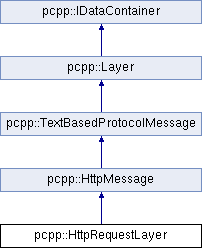
Represents an HTTP request header and inherits all basic functionality of HttpMessage and TextBasedProtocolMessage. The functionality that is added for this class is the HTTP first line concept. An HTTP request has the following first line: GET /bla/blabla.asp HTTP/1.1 Since it's not an "ordinary" HTTP field, it requires a special treatment and gets a class of it's own: HttpRequestFirstLine. Unlike most L2-4 protocols, an HTTP request header can spread over more than 1 packet. PcapPlusPlus currently doesn't support a header that is spread over more than 1 packet so in such cases: 1) only the first packet will be parsed as HttpRequestLayer (the other packets won't be recognized as HttpRequestLayer) and 2) the HTTP header for the first packet won't be complete (as it continues in the following packets), this why PcapPlusPlus can indicate that HTTP request header is complete or not(doesn't end with "\r\n\r\n" or "\n\n") using HttpMessage::isHeaderComplete()
 Public Member Functions inherited from pcpp::Layer
 1.9.1
1.9.1