|
| | ArpLayer (uint8_t *data, size_t dataLen, Layer *prevLayer, Packet *packet) |
| |
| | ArpLayer (ArpOpcode opCode, const MacAddress &senderMacAddr, const IPv4Address &senderIpAddr, const MacAddress &targetMacAddr, const IPv4Address &targetIpAddr) |
| | A constructor that creates an ARP header. More...
|
| |
| | ArpLayer (ArpOpcode opCode, const MacAddress &senderMacAddr, const MacAddress &targetMacAddr, const IPv4Address &senderIpAddr, const IPv4Address &targetIpAddr) |
| |
| | ArpLayer (ArpRequest const &arpRequest) |
| | A constructor that creates an ARP request header. More...
|
| |
| | ArpLayer (ArpReply const &arpReply) |
| | A constructor that creates an ARP reply header. More...
|
| |
| | ArpLayer (GratuitousArpRequest const &gratuitousArpRequest) |
| | A constructor that creates a gratuitous ARP request header. More...
|
| |
| | ArpLayer (GratuitousArpReply const &gratuitousArpReply) |
| | A constructor that creates a gratuitous ARP reply header. More...
|
| |
| arphdr * | getArpHeader () const |
| |
| ArpOpcode | getOpcode () const |
| |
| MacAddress | getSenderMacAddress () const |
| |
| MacAddress | getTargetMacAddress () const |
| |
| IPv4Address | getSenderIpAddr () const |
| |
| IPv4Address | getTargetIpAddr () const |
| |
|
void | parseNextLayer () override |
| | Does nothing for this layer (ArpLayer is always last)
|
| |
| size_t | getHeaderLen () const override |
| |
| void | computeCalculateFields () override |
| |
| ArpMessageType | getMessageType () const |
| | Attempts to determine the ARP message type based on the header signature. More...
|
| |
|
bool | isRequest () const |
| | Is this packet an ARP request?
|
| |
|
bool | isReply () const |
| | Is this packet an ARP reply?
|
| |
| std::string | toString () const override |
| |
| OsiModelLayer | getOsiModelLayer () const override |
| |
| | ~Layer () override |
| |
| Layer * | getNextLayer () const |
| |
| Layer * | getPrevLayer () const |
| |
| ProtocolType | getProtocol () const |
| |
| bool | isMemberOfProtocolFamily (ProtocolTypeFamily protocolTypeFamily) const |
| |
| uint8_t * | getData () const |
| |
| size_t | getDataLen () const |
| |
| uint8_t * | getLayerPayload () const |
| |
| size_t | getLayerPayloadSize () const |
| |
| bool | isAllocatedToPacket () const |
| |
| void | copyData (uint8_t *toArr) const |
| | Copy the raw data of this layer to another array. More...
|
| |
| size_t | copyData (uint8_t *dest, size_t destSize) const |
| | Copy the raw data of this layer to another array, with a specified maximum size. More...
|
| |
| void | serialize (ISerializer &serializer) const |
| |
| uint8_t * | getDataPtr (size_t offset=0) const override |
| |
|
| Packet * | getAttachedPacket () |
| | Get a pointer to the Packet this layer is attached to (if any). More...
|
| |
| Packet const * | getAttachedPacket () const |
| | Get a pointer to the Packet this layer is attached to (if any). More...
|
| |
| void | allocData (size_t dataLen, bool zeroInit=true) |
| | Requests the layer to allocate a new data buffer of the specified length. More...
|
| |
| template<typename T , typename... Args> |
| Layer * | constructNextLayer (uint8_t *data, size_t dataLen, Args &&... extraArgs) |
| | Construct the next layer in the protocol stack. No validation is performed on the data. More...
|
| |
| template<typename T , typename... Args> |
| Layer * | constructNextLayer (uint8_t *data, size_t dataLen, Packet *packet, Args &&... extraArgs) |
| |
| template<typename TFactory , typename... Args> |
| Layer * | constructNextLayerFromFactory (TFactory factoryFn, uint8_t *data, size_t dataLen, Args &&... extraArgs) |
| | Construct the next layer in the protocol stack using a factory functor. More...
|
| |
| template<typename TFactory , typename... Args> |
| Layer * | constructNextLayerFromFactory (TFactory factoryFn, uint8_t *data, size_t dataLen, Packet *packet, Args &&... extraArgs) |
| | Construct the next layer in the protocol stack using a factory functor. More...
|
| |
| template<typename T , typename... Args> |
| Layer * | tryConstructNextLayer (uint8_t *data, size_t dataLen, Args &&... extraArgs) |
| |
| template<typename T , typename... Args> |
| Layer * | tryConstructNextLayer (uint8_t *data, size_t dataLen, Packet *packet, Args &&... extraArgs) |
| |
| template<typename T , typename TFallback , typename... Args> |
| Layer * | tryConstructNextLayerWithFallback (uint8_t *data, size_t dataLen, Args &&... extraArgs) |
| | Try to construct the next layer in the protocol stack with a fallback option. More...
|
| |
| template<typename T , typename TFallback , typename... Args> |
| Layer * | tryConstructNextLayerWithFallback (uint8_t *data, size_t dataLen, Packet *packet, Args &&... extraArgs) |
| |
| template<typename TFallback , typename TFactory , typename... Args> |
| Layer * | tryConstructNextLayerFromFactoryWithFallback (TFactory factoryFn, uint8_t *data, size_t dataLen, Args &&... extraArgs) |
| | Try to construct the next layer in the protocol stack using a factory functor with a fallback option. More...
|
| |
| template<typename TFallback , typename TFactory , typename... Args> |
| Layer * | tryConstructNextLayerFromFactoryWithFallback (TFactory factoryFn, uint8_t *data, size_t dataLen, Packet *packet, Args &&... extraArgs) |
| | Try to construct the next layer in the protocol stack using a factory functor with a fallback option. More...
|
| |
| virtual void | serializeLayer (ObjectScope &serializer) const |
| |
| template<typename T > |
| static bool | canReinterpretAs (const uint8_t *data, size_t dataLen) |
| | Check if the data is large enough to reinterpret as a type. More...
|
| |
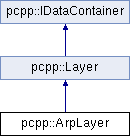
Represents an ARP protocol layer. Currently only IPv4 ARP messages are supported
 Public Member Functions inherited from pcpp::Layer
 1.9.1
1.9.1